Corps d’Afrique
A painful evolution to prove valor
Bureau of Colored Troops is established
Events unfolded quickly regarding blacks serving in the Union Army. Several activities got underway almost simultaneously.
This happened for a lot of the reasons already implied or said in this report. But clearly, one reason was that Union commanders all over were organizing and fielding black regiments on their own, each with different guidance and instructions..
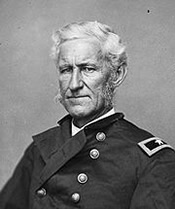
Brigadier General Lorenzo Thomas, USA, served as Adjutant General until March 23, 1863. The Secretary of War did not like him and, by some accounts, banished him to the Mississippi River Valley to get him out of Washington. His new assignment was to take over recruiting blacks.
Recall that General Banks had issued his General Order No. 40 proposing the Corps d’Afrique on May 1, 1863, and then took his Corps to battle at Port Hudson, a proposal which the War Department did not make official, but one which General Banks implemented anyway.
Hondon B. Hargrove, writing Black Union Soldiers in the Civil War, said:
"While Generals Banks, Ullman and Thomas were making good progress in recruiting and organizing black regiments in the Mississippi Valley from Cairo to the Gulf, newly promoted Brigadier General E.A. Wild was busy recruiting and organizing them in North Carolina … Most of the northern states also pursued their own programs on a wider scale than ever before … Those regiments organized without approval by Washington in 1862, and which had finally gained federal sanction, had continued to perform vital military duties after the Emancipation Proclamation came into effect … The results of these disjointed efforts were sufficiently impressive to convince Washington that now is the time to act."
On May 22, 1863, the US War Department issued General Order No. 143, establishing the Bureau of Colored Troops to handle "all matters relating to the organization of colored troops.” It was placed under the Adjutant General. Major Charles W. Foster was named Chief of the Bureau of Colored Troops.
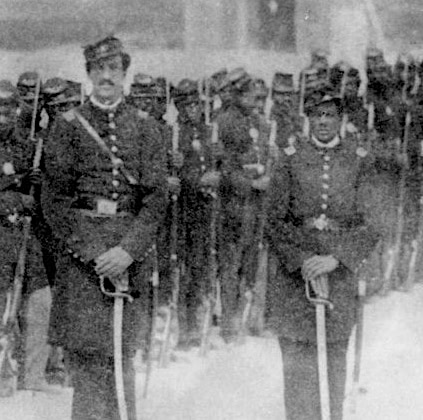
In June 1863, the three Native Guard regiments were redesignated the 1st, 2nd, and 3rd Corps d’Afrique. Brigadier General Daniel Ullman, USA, mentioned previously, became the commander of the 1st and 3rd Regiments of the Corps d’Afrique. Colonel Nathan Daniels commanded the 2nd Regiment. Both were advocates for bringing African Americans into the Union Army.
Joelle Jackson wrote,
“In June 1863, shortly before the final victory was achieved at Port Hudson, the three Native Guard regiments were redesignated the 1st, 2nd, and 3rd Corps d’Afrique. Although they had fought well at Port Hudson, poor treatment by fellow Union soldiers and difficult field conditions led to large-scale resignations by the black officers and desertions by enlisted men.”
On August 1, President Lincoln gave General Thomas his marching orders,
“General! You are going about a most important work. There is a draft down there which can be enforced.”
The President then told General Grant about the Thomas assignment,
“Gen. Thomas has gone again to the Mississippi Valley, with the view of raising colored troops. I have no reason to doubt that you are doing what you reasonably can upon the same subject. I believe it is a resource which if vigourously applied now, will soon close the contest. It works doubly, weakening the enemy & strengthening us. We were not fully ripe for it, until the river was opened. Now, I think at least a hundred thousand can, and ought to be rapidly organized along it’s shores, relieving all white troops to serve elsewhere.”
General Grant reassured the President that this endeavor had his full support, telling him, “By arming the negro we have added a powerful ally. They will make good soldiers and taking them from the enemy weaken him in the same proportion they strengthen us.”
As already discussed, all black units of the Union Army were being formed throughout the Union. The Corps’ d’Afrique evolved from the Louisiana Native Guard, Union.
The designation United States Colored Troops (USCT) replaced the varied state titles that had been given to the African American soldiers over the next year. Instead of state designations, they became United States Colored Troops (USCT), and the various units became United States Colored Infantry, Artillery, or Cavalry.
It took time to convert the Corps d'Afrique to the USCT. That would be normal for a national government. It had to establish the Bureau of Colored Troops, then man it up, designate leaders, set up offices, write rules and regulations, etc., then get down to work assimilating the state units into the USCT. Then mix in the usual disorganization and confused reporting by the press, and you can see how the effort might seem slow to bear fruit.
Joelle Jackson continued,
“In April 1864 the Corps d'Afrique was dissolved, and its members placed in the newly organized 73rd and 74th Regiments of the United States Colored Troops (USCT). At the end of the war in 1865 only about 100 of the original 1,000 men were still in the Army.”
By war’s end, the Corps d’Afrique had 25 regiments and five regiments of engineers. Each of these was designated as numbered USCT units. The original four Louisiana Naive Guard Regiments became the 1st, 2nd, 3rd, and 4th Regiments of the Corps d’Afrique and were then re-designated the 73rd, 74th, 75th, and 76th USCTs.
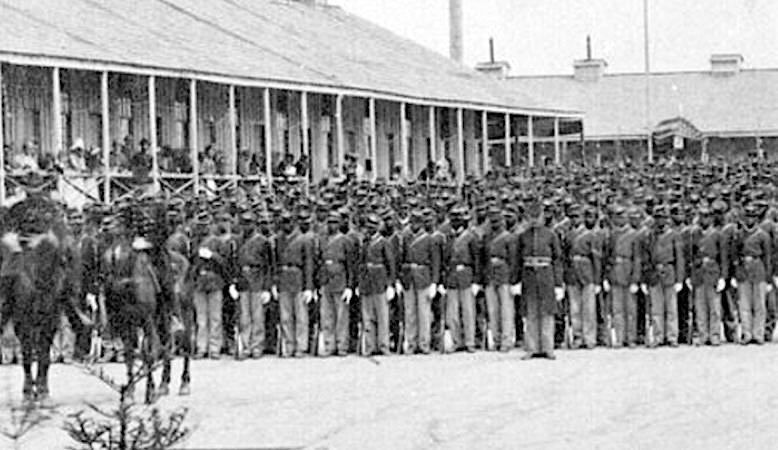
Approximately 175 regiments of more than 178,000 free blacks and freedmen (emancipated slaves) served during the last two years of the Civil War. By the end of the war, they made up about 10 percent of the Union Army. The USCT suffered 2,751 combat casualties during the war, and 68,178 losses from all causes, with disease being the worst for both black and white.
Meet some Native Guard black officers, for man an unhappy ending
Click to zoom graphic-photo