Corps d’Afrique
A painful evolution to prove valor
Meet some black officers
For some an unhappy ending
Incredibly, despite their gallant service at East Pascagoula and Port Hudson, General Banks, who did not like black officers in the Corps d’Afrique, decided to eliminate all of them still in the Corps. He said they were a source of "constant embarrassment and annoyance." He said their use "demoralizes both the white tools and negroes." He called black officers arrogant. He informed President Lincoln in August 1863 that black men were "unsuited for this duty." This, after they had fought so valiantly for him at East Pascagoula and Port Hudson.
James Hollandsworth, author of The Louisiana Native Guards: The Black Military Experience During the Civil War, wrote,
”The real problem was with white troops, who did not want to salute black officers, did not want to obey them, did not want to stand while they sat, etc.”
Hollandsworth wrote, "A provost marshal under Banks told a friend after arriving in New Orleans that the black officers looked 'like dogs in full dress, ready to dance in the manger. Would you like to obey such a fool?"
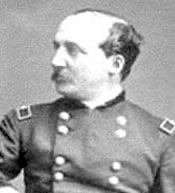
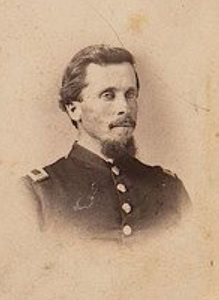
Then Colonel Charles Paine, USA of the 2nd Louisiana Native Guard (Corps d’Afrique), said, "They ought never to put a shoulder strap on a darkey." He is shown here as a brigadier general.
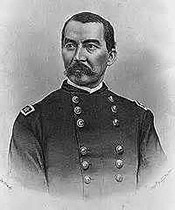
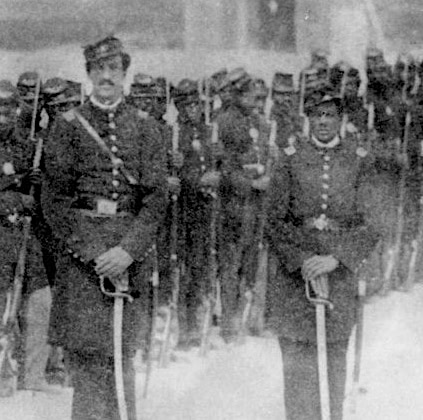
Colonel John A. Nelson, USA, commanded the 3rd Regiment Native Guard (Corps d’Afrique). His men did not respect him. All 16 of Nelson's black officers signed a mass resignation in a petition to General Banks.
In their book Thank God My Regiment an African One, by Clare B. Weaver and Edwin C. Bearss, the authors said "the petition to General Banks cited numerous prejudicial situations: 'even our own Regimental commander (Colonel Nelson) has abused us, under cover of his authority.' Nelson had been warned earlier against impressment of blacks during their recruitment, but had paid little attention and even continued his roughshod methods later." Nelson experienced other problems as well; e.g. arrested at Port Hudson for conduct unbecoming an officer involving a woman.
The mass resignations in the 3rd Regiment bolstered Banks' feeling that he needed to purge all black officers from the Corps d'Afrique. The 3rd Regiment had a mix of white and black line officers. However, the 1st and 2nd Regiments had all black line officers. This presented Banks with a challenge: How to get rid of them?
Banks came up with a solution: Set up an examining board to evaluate these black officers. Hollandsworth wrote that "Banks let it be known that he intended to pay black enlisted men and their white field officers but not the black line officers." White officers would not have to face the examination board.
Three black officers from the 2nd Regiment were discharged from the service on February 24, 1863, for reasons of incompetence. The remaining black officers on Ship Island with the 2nd Regiment complained and formulated their grievances. They knew the board was a way to force them out. Four more black officers resigned. However, the rest remained.
In May 1863, Captain William B. Barrett wrote General Ullman and asked if he intended to remove all black officers while organizing the Corps d'Afrique. Ullman responded that he had come “to no determination whatever" on this matter. He wanted to wait until he took command. Barrett remained, but eight more black officers resigned, feeling they could see dismissal coming their way.
In August 1863, the remaining black officers were on the docket to face the examination board. That board was manned by white officers, often junior in rank. Six more black officers resigned, including Captain Barrett and Major Dumas. There were now only seven left. One more would resign, one more was dismissed for leaving his post and falling asleep, and one more resigned citing prejudice, but his commander said he "has neither the respect or confidence of his men." That now leaves four. One more resigned in March 1863, though once again his commander said he mismanaged the discipline of his company. Two more then resigned, leaving only one, Capt. Charles Sauvenet. He retained his commission until the end of the war.
That left the 1st Regiment. By my count, 21 left between mid-August 1863 and October 1863, for varied reasons. Five of them had passed the examination board. Eight black officers were left, and each passed the examination board as well. But seven of those resigned by March 22, 1864, leaving only one, Capt. Louis A. Snaer. He retained his commission until the end of the war.
Brigadier General George Andrews assumed command of the Corps d'Afrique on July 10, 1863. He was the one to establish the examining boards and a school for white officers. That said, he advocated recruiting and enlisting colored troops, saying, "the colored troops will prove themselves superior to the white troops." He believed the white officers could instruct and train them to be such.
In a letter of November 4, 1863, written to Colonel C.C. Dwight, President of the Examining Board, Andrews said:
"I cannot at present under any circumstances approve the application of a colored person for a commission in the Corps d'Afrique. The time for this may come, but it is not now."
So that was that.
I have not researched this, but it might be an excellent study to examine how the loss of all these black line officers impacted the overall officer census — I think it created an officer shortage. And then examine how it affected the black enlisted men.
I wish to note the book, Freedom: A documentary history of emancipation, 1861-1867, Series II The Black Military Experience, published by the Freedmen and Southern Society Project." It contains many letters of resignation written by black Native Guard officers. You might find these interesting.
Meet a few Black Officers of Corps d'Afrique
I want to introduce a few of the officers of the Corps d’Afrique. Keep the purge just discussed in mind.
Captain Andre Cailloux, USA
Captain Andre Cailloux, killed by artillery in the Battle of Port Hudson, is arguably one of the best-known Native Guard officers. He was the commander of E Company, 1st Regiment. Cailloux is an interesting fellow who would have an enormous impact on Louisiana and New Orleans specifically.
He was a Creole, esteemed and wealthy, educated in France, including the military arts. He first joined the CSA’s 1st Louisiana Native Guard and served as a lieutenant. He earned his living as a car maker. He became a leader of the free Afro-French Creole community of New Orleans. This community became a distinct one sandwiched between the white colonists and the majority of black slaves. He was also one of the best boxers in the city, an active supporter of the Institute Catholique, a school founded in the Faubourg Marigny district of New Orleans in 1840 for orphaned black children. He was fluent in English and French.
Cailloux was told to enlist only free men of color, but he looked the other way when escaped slaves came to join.
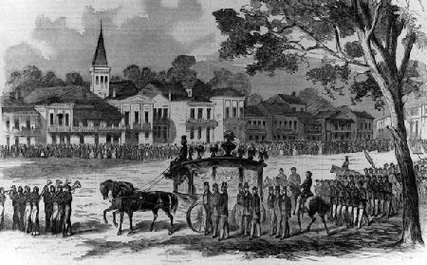
I mentioned he was killed at Port Hudson. His decomposed remains were recovered from the battlefield and brought to New Orleans after the battle was over. The Confederates would not allow the men to gather their dead until then. James Hollandsworth wrote:
"His (Cailloux) was a somber yet impressive funeral. The band of the 42nd Massachusetts Infantry played the usual dirges, while six black captains from the 2nd Regiment of Native Guards acted as pallbearers. Flowers were strewn around the flag-draped casket, and candles burned continuously. After receiving the last rites of the Catholic Church from a white priest, Cailloux's body was borne on the shoulders of eight black soldiers and placed in the hearse. Two companies of recruits for a new black regiment acted as an honor guard. About a hundred sick and convalescing soldiers from the Native Guards were also in attendance. Large crowds of civilians, both black and white, stood on the banquette along the Esplanade waiting for a chance to see the hearse as it passed. Eventually, the body reached the Bienville Street Cemetery, where Captain Cailloux, 'the blackest man in New Orleans,' was laid to rest."
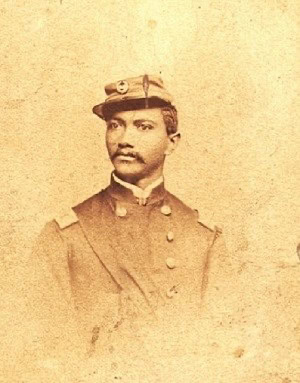
Major Francois Ernest Dumas, USA
I mentioned earlier that General Banks did not allow people of color to be field grade officers (Majors and above) with one exception: Major Francois (Francis) Ernest Dumas, shown here, of the 2nd Regiment, Native Guard. He was a Creole of color. He had been a reasonably wealthy man, said to be worth a quarter million dollars, and a slaveholder, educated in France. Yes, he was a slaveholder. He freed his slaves and organized them into a company in the 2nd Regiment of the Louisiana Native Guard. Dumas would be the first black field grade officer in the Union Army, was second in command of the 2nd Regiment, and was one of only two black field grade officers in the entire Union Army. He had earlier joined the 1st Louisiana Native Guard, CSA.
Shirley Elizabeth Thompson, writing Exiles at Home: The Struggle to Become and American in Creole New Orleans," wrote:
"Dumas and three other officers earned special commendation as officers who were 'constantly in the thickest of the fight, and by their unflinching bravery and admirable handling of their commands … reflected great honor upon the flag under and for which the so nobly struggled.'"
Dumas resigned on July 3, 1863, with no reason given. However, there is credible evidence that he resigned because of General Banks' purge of black officers from the 2nd Regiment. He reportedly refused to face the examining board.
Following the Civil War, Dumas ran to be nominated for governor and lost by a very narrow margin, some two votes, I understand. He was offered the number two spot and declined.
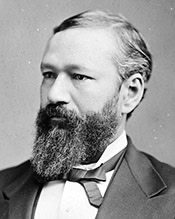
Pinckney Benton Stewart Pinchback, born with the last name Stewart, better known as PBS Pinchback
PBS Pinchback was born in Georgia but chose to join the Union Army. He helped raise several companies of the 1st Louisiana Native Guard while in New Orleans. He was commissioned a captain and commanded Alpha Company, 2nd Regiment. He was passed over twice for promotion.
He resigned in September 1863 after seeing so many blacks resigning from the three Native Guard regiments. He told General Banks he would resign if "you have concluded that none of us are fit to command." He had been the only colored soldier at Ft Pike and felt the sting of prejudice while there. He left the service in November 1863.
Following the war, he was active in the Republican Party and became the most powerful black politician in Louisiana. In 1868, he was elected a state senator in Louisiana. He became president pro tempore, where blacks held seven of 36 seats. He served as acting lieutenant governor and, as a result of impeachment proceedings against the governor, became acting governor on December 9, 1872, serving for about six weeks. He would be the first African American elected from Louisiana to the US Congress.
William F. Keeling
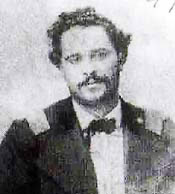
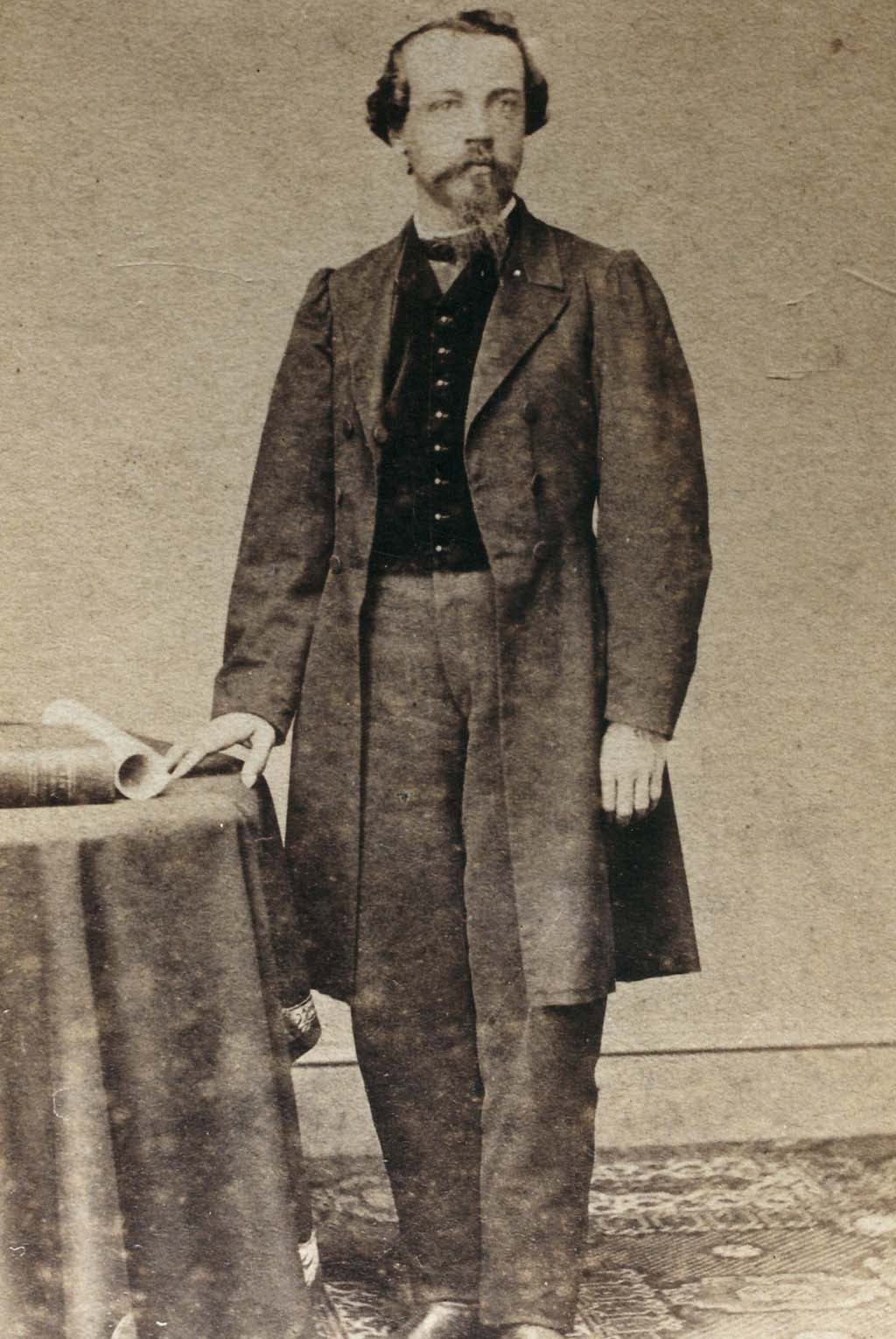
William F. Keeling, from Norfolk, Virginia, was a 1st Lieutenant in the 2nd Regiment. I believe this is a picture of him. A three-member examination board met with him on February 9, 1863. The board determined his commission was issued provisionally and rescinded it. He served on the National Convention of Colored Men held at Syracuse, New York, in October 1864. Black representatives from Florida, Louisiana, Mississippi, North Carolina, Tennessee, and Virginia attended. Keeling was one of five from Virginia and was elected one of the convention's vice presidents. This was the first time Afro-Virginians freely and openly attended a political convention. The Union Army had been in and out of Virginia since 1861, but by this time, it was enjoying successes. Keeling helped draft a "Declaration of Wrongs and Rights" in which the delegates pledged their support to Lincoln, the Union, and the defeat of the Confederacy. The delegates pointed to the sacrifices made in battle by black Union soldiers and demanded respect and their rights as American citizens.
E. Arnold Bertonneau
Captain Arnold Bertonneau served with the 2nd Regiment as well. He had been a New Orleans wine merchant, joined the 1st Louisiana Native Guard, CSA, and then joined the Union Native Guard responding to General Butler's call. He resigned his commission in protest due to the mistreatment and misuse of his men. He passed the examination board but resigned nonetheless and returned to New Orleans. He became a leader in the black suffrage movement after President Lincoln restricted voting to white males only. He led a petition campaign and obtained more than 1,000 signatures demanding that black men be free to vote. He delivered a stirring speech in 1864 entitled, "Every man should stand equal before the law." He was a member of the Constitutional Convention of April 1868, which gave Louisiana its first Reconstruction Constitution.
John Crowder
John H. Crowder was a 2nd Lieutenant in the 1st Regiment, born in Louisville, Kentucky. He lied about his age, joining when he was 16, perhaps the youngest officer in the Union Army. He came from a poor but free black family. His mother and a prominent black clergyman taught him how to read and write, though I have read a source that maintains he taught himself while serving as a cabin boy and later steward on the Mississippi River. His father had abandoned the family shortly after John was born to participate in the Mexican War and never returned. As a result, his mother, Martha Ann Stars, moved Crowder to New Orleans, where he joined the National Guard.
Bernie Mackinnon's Blog item, "Taps for John Crowder," said:
"A handful of his letters exist in the special collections library at the University of North Carolina, Chapel Hill, most of them written to his mother. In one, he remarked to her, 'If Abraham Lincoln knew that a colored Lad of my age could command a company, what would he say?' Crowder's youth brought consternation within the ranks, however, especially since he outshone other officers in leadership qualities. So, besides regular insults from white citizenry, he had to contend with them from fellow officers. One in particular, a jealous captain later prosecuted for cowardice, started spreading false rumors about Crowder's personal conduct. When one of this captain's men committed a lewd act in front of an older woman—a friend of Crowder's who had nursed him through a fever—the young lieutenant reported it, his nemesis having failed to do so. 'I remember your first lesson,' he wrote his mother, 'that was to respect all females.' After this, the slander campaign against him intensified. But he was resolved not to be driven from the Native Guard—'to stay in the service, as long as there is a straw to hold to.'"
Crowder was in the thick of the attack on Port Hudson in 1863. He and the others, including Captain Andre Callioux, waited to attack Port Hudson at dawn on May 27, 1863. They were told they would lead the charge. As I have discussed, the attack was a disaster. The regiments got within 200 yards of the main Confederate works when they experienced a "hail of canister shell and rifle fire that ripped through the lines of black troops," according to Joseph Glatthaar. Glatthaar went on to write, "By dint of sheer derivation, the men pressed onward to a slaughter." Crowder fell early and was killed in action. His body along with the others who fell were left on the battlefield to rot. The Native Guard, under a white flag, attempted several times to get to the bodies of the fallen, but the Confederates refused.
Glattharr wrote further, "Had an officer with authority an any sense examined the Confederate position, the charge of the 1st and 3rd Louisiana Native Guards would never have taken place … It should never have happened."
Crowder and Cailloux were among the first black officers to die fighting for the Union. You will recall the magnificent funeral held for Cailloux. Crowder received a pauper's funeral as his mother had no resources.
Charles S. Sauvinet
Captain Charles St. Albin Sauvinet was with the 2nd Regiment. He had also served with the 1st Louisiana Native Guard, CSA. He remarked, "If we had not volunteered, they would have forced us into the ranks." He helped General Butler raise and organize the new Native Guard, USA, initially serving in the 1st Regiment. He was fluent in German, Spanish, and French. He did not resign, leaving the service in 1865, compiling the longest continuous record of all black officers. After the war, he became the first African-American to be the Orleans Parish civil sheriff.
Lt Colonel Alexander Thomas Augusta
Alexander Thimas Augusta was born to free African American parents in Virginia. He applied to study medicine at the University of Pennsylvania but was refused admission. He went to Canada to study and received a degree in medicine. He offered his services to President Lincoln and was given a president commission in the Union Army in 1862. In 1863 he received a major’s commission as a surgeon and was the first African American physician of eight in the Union Army. He received promotion as a brevet lieutenant colonel but the rank was not confirmed. Alexander Augusta was the first Black officer buried with full military honors in Arlington National Cemetery.
By my count, twenty-four African Americans received the Medal of Honor during the Civil War.
Click to zoom graphic-photo