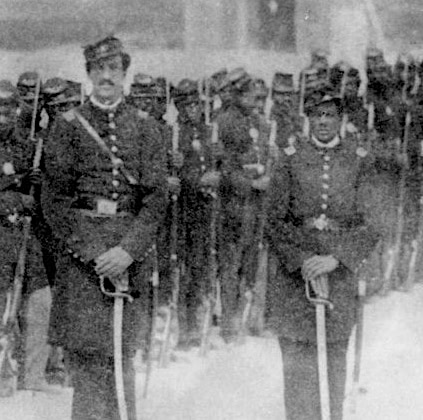
Corps d’Afrique
A painful evolution to prove valor
The question of Strategy
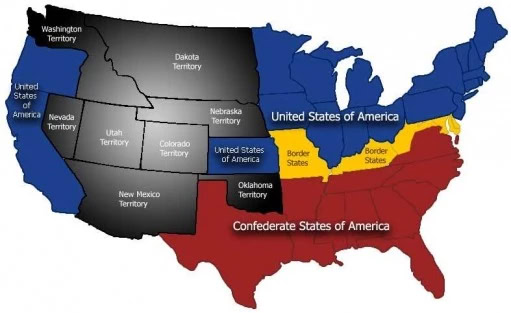
This is a map of the secession and the Union. The southern states from South Carolina to Texas, seven of them, were the first to secede. Then, after the fall of Fort Sumter, the states from Virginia to North Carolina and west to Arkansas seceded, making 11 in all in the CSA, marked on this map. The yellow states were slave states that remained in the Union. The northern states of the United States are in blue.
The Mississippi River served as a dividing line. There already was a north-south dividing line. The river established an east-west dividing line.
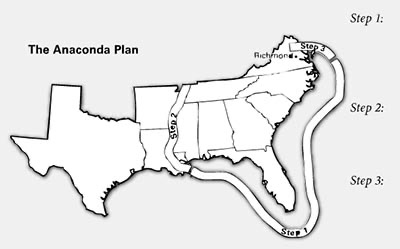
Union General-in-Chief Winfield Scott, known to some as “Old Fuss and Feathers,” was thought to be one of the best American commanders of his time. In May 1861, he developed a Union strategy to defeat the Confederacy known as the Anaconda Plan.
The centerpiece of this strategic plan was to avoid invading the South with massive numbers of troops. An objective was to limit confrontation and cause minimal casualties. In effect, it was a passive plan to starve out the South and cause it to give up on its secession moves; some called it a conciliatory plan.
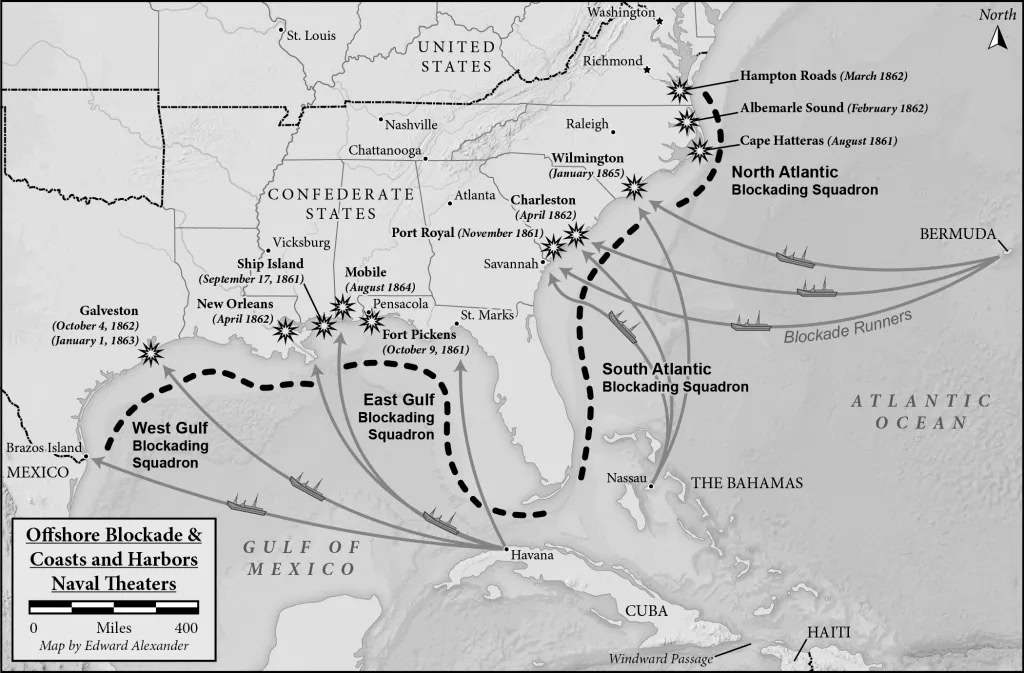
The Anaconda Plan involved blockading all southern ports to stop southern trade with the outside world and seizing control of the Mississippi River to cut the Confederacy in two, an action that would stop the flow of supplies eastward and westward.
- Step 1 was to execute the blockade of all southern ports.
- Step 2 was to control the Mississippi River and divide the Confederacy.
- Step 3 was to capture Richmond and cause the Confederacy to buckle.
Under this strategy, Union forces would take up defensive positions and repel Confederate attacks into the North. As southern ports were taken, Union troops could be steamed in to hold forts in those areas. Finally, the idea was to float down the Mississippi, taking ports and forts along the way, and then holding those. It was referred to as “Scott’s Great Snake.”
President Lincoln is said to have thought the plan was too timid and unrealistic, and seemed to dismiss it. However, he very much liked the idea of blockading southern ports. Very early in his presidency, Lincoln set forth the Union’s first naval goal: blockade the southern coasts. That synchronized with the Anaconda Plan.
Most Union generals did not like this plan. Secretary of the Navy Gideon Welles opposed the plan and opposed Lincoln's desire to blockade southern ports. He would later relent.
The most significant problem with the Anaconda Plan was that the Union lacked a strong navy.
The generals opposing the plan wanted to attack the South, employ the Union’s overwhelming industrial and military might, and defeat the South in the South. Furthermore, they wanted to fight on land west of the Mississippi, ignoring Confederate fortifications. This plan sought a rapid victory, while Scott’s would take longer. The Union generals aimed to take Richmond, an action they thought would quickly force the collapse of the Confederacy. The press snapped up attention-grabbing headlines like, "On to Richmond."
The Anaconda Plan was never officially adopted, but Lincoln followed it as a rough draft. He especially liked and understood controlling the Mississippi River. The plan would have a significant impact on the war in the Western Confederacy.
As it turned out, the Union lacked top-quality generals at the helm. Perhaps surprisingly, most of the top generals were Democrats, not Republicans. A succession of generals-in-chief were fired for failures in the ground war. Furthermore, Lincoln appointed too many generals for political purposes, oftentimes appointing politicians with no military background.
Many experts I have read have said the Confederacy had the best general officers, but lacked the resources. Even lacking resources, the Confederate Army made extraordinary gains in the war. The Confederate Army was not an outfit the Union could knock out overnight. It was strong with fierce fighters.
Lincoln outlined the Union’s first naval objective: blockading the southern coasts, which stretched about 3,500 miles. Gideon Welles, the Navy secretary, initially disliked the plan partly because he knew he didn't have enough naval resources. However, he eventually supported the idea and led a significant effort to build new warships, including buying and converting merchant vessels.
At the beginning of the war, the Union had 42 commissioned warships. The Confederacy had none. While that was true, critics of Secretary Welles called it Welles' "soapbox navy," as the Civil War Trust put it, "A motley assortment that ranged from old sailing ships to New York harbor ferryboats."
David G. Surdham, writing “The Confederate Naval Buildup,” said the Union had to face some formidable challenges:
- It would take time to build the required ships.
- Naval technology was changing rapidly. Both sides understood the importance of ironclad ships.
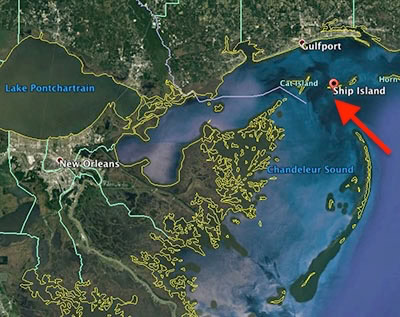
New Orleans was the largest Confederate port and the Confederacy's largest city. The US Navy was incapable of sealing off all the channels. New Orleans was 60-100 miles upstream of the Mississippi, depending on who is measuring and how, before that river emptied into the Gulf of Mexico.
The arrow on the map points to Ship Island. It became a central piece of geography.
The Union experienced many problems developing and sticking to a strategy for victory in the Civil War. Strategies changed frequently and in some cases were nonexistent. However, there seemed to be one point of general agreement: take control of the Mississippi River to split the Confederacy in two. The debate would center on whether to come down the river or go up the river.
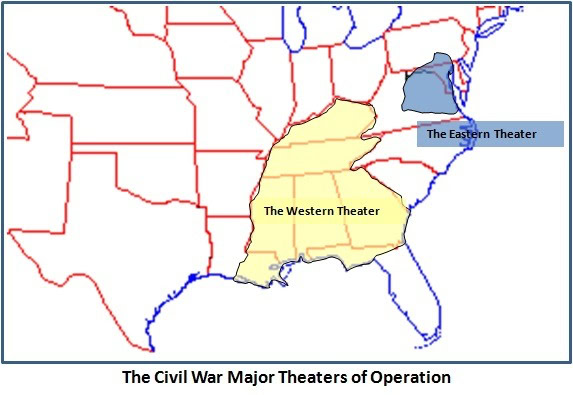
There were two theaters of war in the Civil War: the Eastern and Western. Most Americans are familiar with the Eastern Theater, but not so many with the Western. The Eastern Theater was small, the Western vast. The Western Theater was so vast that it would be hard to take it, and conversely, it would not be easy to defend.
In the West, rivers flowed generally north to south. They became major Union invasion routes. The Mississippi River was the Grand-daddy of them all. It was the only way to move men and supplies.
Washington, DC, and Richmond were close to each other, and both were in the East. Therefore, senior commanders worried more about the East. As a result, generals in the West found they could take far greater liberties. Resources were also more available to the East. For his part, President Lincoln understood the West better than the East and provided his generals in the West with better political support.
With the blockade put in place along the southern coastline, Union troops would use the vast network of rivers to move into the Confederacy. Union efforts to take Richmond failed. Confederate forces eventually invaded Virginia and Maryland and moved into Pennsylvania.
While many of us see General Ulysses S. Grant as one who achieved victory in Appomattox, Virginia, he earned his spurs fighting in the West. A significant reason for his success was that he launched joint naval and ground force attacks from the river network.
Three of the more meaningful battles of the war occurred at Shiloh, Tennessee, and Vicksburg and New Orleans, Mississippi, the latter two of which led to the Union controlling the Mississippi River. Taking those led to the capture of Chattanooga and Nashville, Tennessee, Atlanta, Georgia, and major victories in South and North Carolina. Richmond was trapped between the North and the South in the Eastern Theater.
Click to zoom graphic-photo