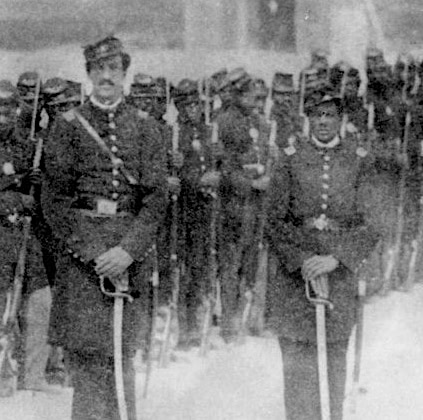
Corps d’Afrique
A painful evolution to prove valor
Corps d’Afrique goes to battle
At long last, Banks decided to attack Port Hudson. He had been told Grant would send some reinforcements from the Vicksburg area, and that a good many Confederate forces in Port Hudson had moved up to Vicksburg to help defend it.
Up until this time, the Louisiana Native Guard, USA, now the Corps d’Afrique, had been relegated to menial tasks. But now it would go to battle, at the Battle of Port Hudson.
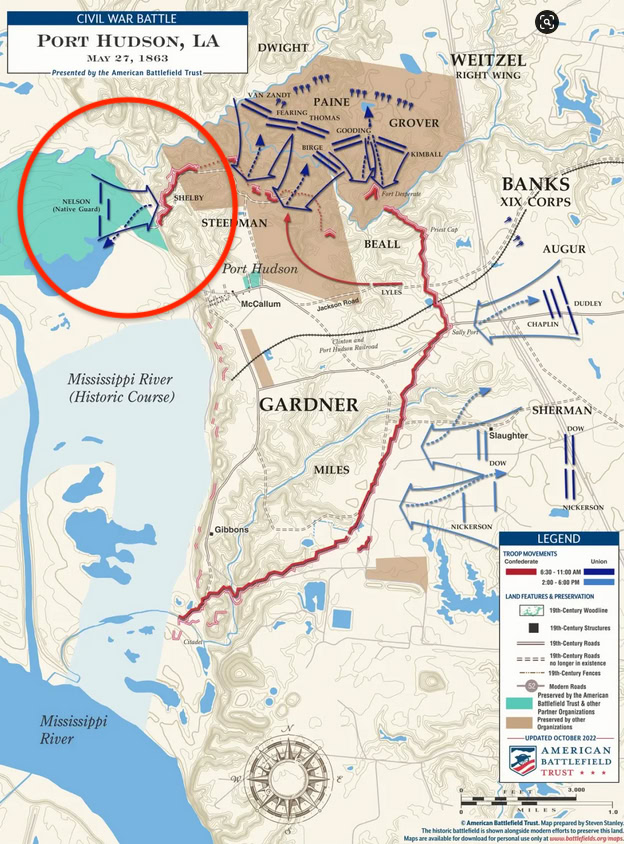
On May 11, 1863, Banks committed the 3rd Infantry Corps d’Afrique to build bridges to support the movement of forces against Port Hudson. By May 22, Banks' force increased from 30,000 to 40,000 troops, pitted against an estimated 7,500 Confederates. He deployed his forces to surround the city. On May 27, he launched his attacks.
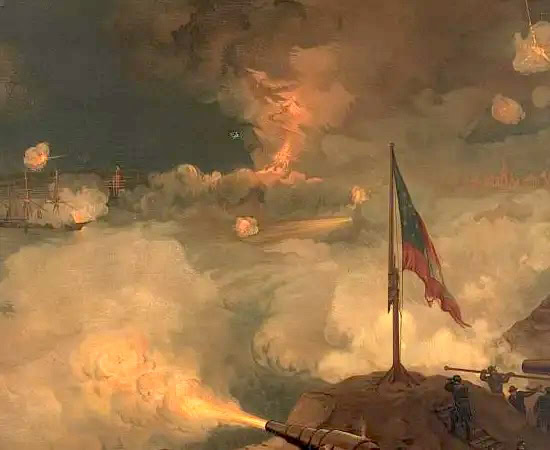
Going against the recommendations of his subordinate officers, Banks decided to launch a full-scale infantry assault on the Confederates’ fortifications, hoping to overwhelm the Confederates and force a quick victory. Behind those fortifications, however, were extensive artillery positions.
Among all his forces, he committed the 1st and 3rd Regiments of the Corps d’Afrique to the battle. They were assigned to Brigadier General William Dwight, USA.
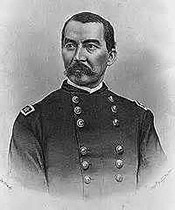
Dwight had not intended to use the Corps in battle, but decided he had no choice as his other forces had failed to advance. He committed the Corps to a heavily fortified section at the extreme left of the Confederate lines. As a result, the Corps was not in the best position to launch an assault. Nonetheless, off they went through “the heavy crossfire from rifles, field artillery, and heavy coast guns.”
Sean Michael Cook has written, “For the North, May 27, 1863 would be one of the cruelest days of the Civil War. On that day Nathaniel Banks hoped to take Port Hudson by storm.”
Terry Jones, in his paper “Louisiana ‘Native Guards’ fight well for Union," wrote:
“William Dwight, Jr., a thirty-one-year-old Massachusetts (brigadier) general, commanded the portion of the battlefield that included the Native Guards (Corps d’Afrique). Dwight wrote that he believed Banks had decided to use the black soldiers in order ‘to test the negro question. . . . The negro will have the fate of his race on his conduct. I shall compromise nothing in making this attack for I regard it as an experiment.’
“Incredibly, Dwight's ‘experiment’ did not include scouting out the position the Native Guards (Corps d’Afrique) were to attack or even studying maps of the area. As it turned out, Louisiana's black Union soldiers were being sent into a tangled maze of felled trees, thick brush, and irregular ground, which was, perhaps, the strongest part of the Confederate defenses. General Dwight remained in the rear, drinking throughout the entire fight."
Captain Andre Cailloux, about whom I will talk more later, commanded E Company. I've found two excellent descriptions of what happened.
The first is by D. Terry Jones, just mentioned and quoted:
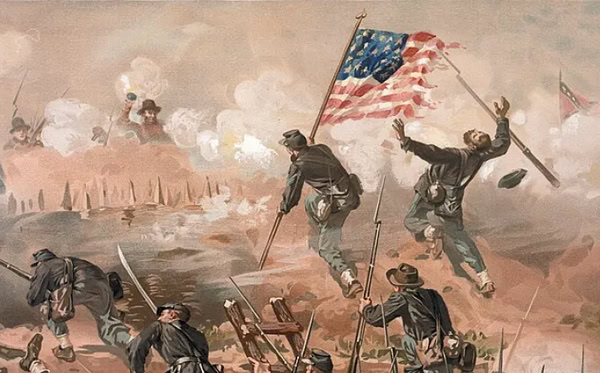
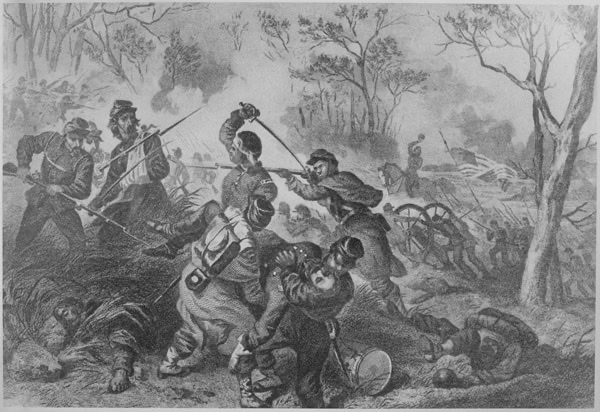
“At about 10:00 a.m., the Native Guards (Corps d’Afrique) moved forward across the six hundred yards of ground that separated them from the enemy. A third of the way across, Confederate artillery opened up with what was described as ‘shot and shells, and pieces of railroad iron twelve to eighteen inches long.’ One shell took off the head of the 1st Regiment's color bearer and scattered his brains on the men near him. Despite the horror, two soldiers stepped forward and vied for the honor to carry the flag. Captain André Cailloux, one of the few black officers in the Union army, had his left arm shattered above the elbow, but he continued to lead his company forward until another bullet killed him instantly. When Cailloux's men saw him go down, they fired one volley and retreated in confusion. The Confederates kept up a steady fire, and one later wrote, ‘We mowed them down, and made them disperse, leaving their dead and wounded on the field to stink.
“Out of the approximately 1,000 Native Guards (Corps d’Afrique) who participated in the attack, 36 were killed and 133 were wounded. The 60 Confederate defenders facing them did not lose a single man. For the entire day, Banks lost about 2,000 men to the Confederates' 500 casualties.”
The second description comes from Stephen J. Ochs, highlighted earlier:
"On the morning of May 27, the 1st and 3rd regiments (Corps d’Afrique) received orders to participate in a general assault on the fortifications surrounding Port Hudson. Their objective was to storm a position on the bluffs protected by rifle pits, a swamp and a rebel engineered backwater from the Mississippi River. Cailloux’s company would bear the regimental standards and spearhead the assault over an area fully exposed to rebel fire.
"At 10 a.m. the bugle sounded and the Native Guards (Corps d’Afrique), forming a long line two ranks deep, emerged from the woods in good order, advancing toward the bluff about 600 yards away. At a distance of about 200 yards, the Confederates began to unleash withering musket and artillery fire at the advancing troops. The barrage threw the leading elements into confusion and they broke and ran to cover among willow trees. Cailloux and other officers rallied their men several times. Finally, Cailloux led a charge of screaming and shouting men that reached the backwater, about 200 yards from the bluffs. At that point, the Guards fired their first and apparently only volley. By then, Cailloux had been hit in the left arm, but he kept going. His arm dangling by his side, Cailloux held his unsheathed sword aloft in his right hand and in French and English hoarsely exhorted his soldiers to follow him.
"As he moved in advance of his troops across the flooded ditch, Confederate artillery opened up with solid shot, grape and canister, while the infantry rained down lead. In the maelstrom of fire, Cailloux was struck in the head and killed.
"Only the availability of trees, stumps and other obstacles prevented a complete slaughter of the rest of the troops. At that point, the 1st Regiment broke and fell back, seeking shelter from Confederate artillery in a nearby willow forest until nightfall. All along the line that day, the Confederates repulsed Union forces, inflicting heavy losses."
These Native Guards (Corps d’Afrique) were the first African American soldiers to see combat in a significant battle in this war. Regrettably, the attack did not succeed. The force had to retreat or face annihilation. However, praise for their performance spread like wildfire, and the white officers sang their praise - the Corps d’Afrique had proven they would and could fight with considerable valor.
The battle failed in large part due to a series of errors made by General Banks. These included attacking these fortifications by rushing infantry at them instead of conducting a siege; failing to instruct his four generals when to attack, resulting in their attacking at different times in an uncoordinated fashion; and running his forces through rugged terrain and into multiple artillery crossfires.
Banks launched a second assault that also failed. He now decided to do what he had originally been advised to do: lay siege to the city.
The Civil War Trust wrote:
"On May 27, after their frontal assaults were repulsed, the Federals settled into a siege which lasted for 48 days. Banks renewed his assaults on June 14 but the defenders successfully repelled them. On July 9, 1863, after hearing of the fall of Vicksburg, the Confederate garrison of Port Hudson surrendered, opening the Mississippi River to Union navigation from its source to New Orleans."
This was the most prolonged siege in US military history. General Grant took control of Vicksburg, Mississippi, on July 4, 1863. The Union now controlled the entire Mississippi River.
In June 1863, the three Native Guard regiments were redesignated the 1st, 2nd, and 3rd Corps d’Afrique.
Click to zoom graphic-photo