Corps d’Afrique
A painful evolution to prove valor
Union capture of New Orleans
Capturing New Orleans took on significant importance early on.
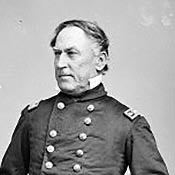
The US Navy’s West Gulf Blockading Squadron, led by Captain David Farragut, USN, “captured” New Orleans on April 29, 1862. However, Major General Benjamin Butler had to occupy and hold it. The actions by Butler form the roots of the Corps d’Afrique. I’ll walk you through these events.
In early 1861, Lt. Commander David Porter, USN, blockaded several cities, including Pensacola, Florida, and Mobile, Alabama, and he then set up a blockade at the mouth of the Mississippi River. He spent most of 1861 blockading that river. He was promoted to commander in August 1861. In November 1861, his ship, the USS Powhaten, returned to New York City, and he was ordered to go to Washington to participate in the planning to capture New Orleans. He advocated doing that.
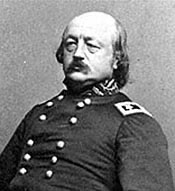
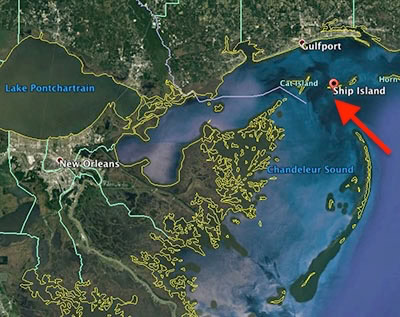
Also in 1861, Major General Benjamin Butler, USA, raised a volunteer force that was to fight in the New England states. He focused on clearing the Confederates from the eastern shore of Virginia. He observed that the Confederates had left that area. So, he then focused on the Gulf Coast. He planned to attack Mobile, Alabama, or seek a foothold in Texas, and then turn to capture New Orleans. His first step was to occupy a place called Ship Island. The Confederates had evacuated it in September 1861.
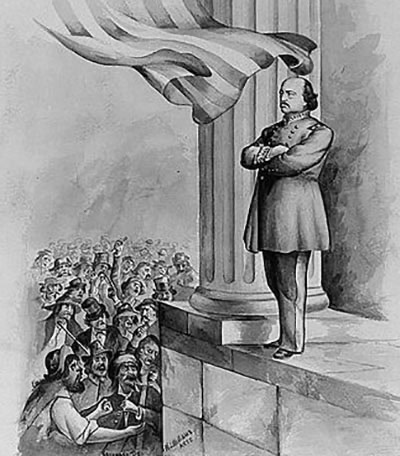
General Butler will remain a focal point of this report as we proceed. Keep your eyes on him. He was quite a rascal.
Neither the powers to be in the North nor the South knew about Butler's plans to capture New Orleans. He saw that Ship Island, shown on this map, presented a superb base for deployment either to Mobile, Alabama, Texas, or New Orleans. There is an outstanding "Historic Resource Study of Ship Island" by Edwin C. Bearss that provides a fabulous and detailed history of the island since the seventh century.
Butler took 2,000 soldiers from the 9th Connecticut and 4th Massachusetts with him aboard the SS Constitution, left Boston Harbor on November 21, 1861, and arrived at Ship Island on December 2. As plans for New Orleans started to solidify, some 15,000 Union troops would be on the island by April 1862.
But let’s back up to the naval planning. Gustavus V. Fox was the Assistant Secretary of the Navy at the time, appointed on August 1, 1861. He was a Naval Academy graduate and a strong advocate of naval power. He focused considerable attention on controlling the Mississippi. In late 1861, he developed a proposal for Gideon Welles, the Secretary of the Navy, and President Lincoln to launch a naval attack on New Orleans from the Gulf of Mexico, then turn the city over to the army. This fit nicely with what General Butler was planning.
Once New Orleans was captured, naval forces would progress up the Mississippi to Vicksburg. Fox knew General Butler was occupying Ship Island near the mouth of the Mississippi, a perfect jumping-off point for his operation.
President Lincoln was skeptical, instead feeling more comfortable with a land invasion from the north. The Fox plan required only a small land force to take the city. General McClellan, who was not enamored with the plan, worried it would eat up a lot of his forces, but did acquiesce to 10,000-15,000 troops for the operation. And, as it turned out, General Butler had about 2,000 troops already at Ship Island and was building to 15,000.
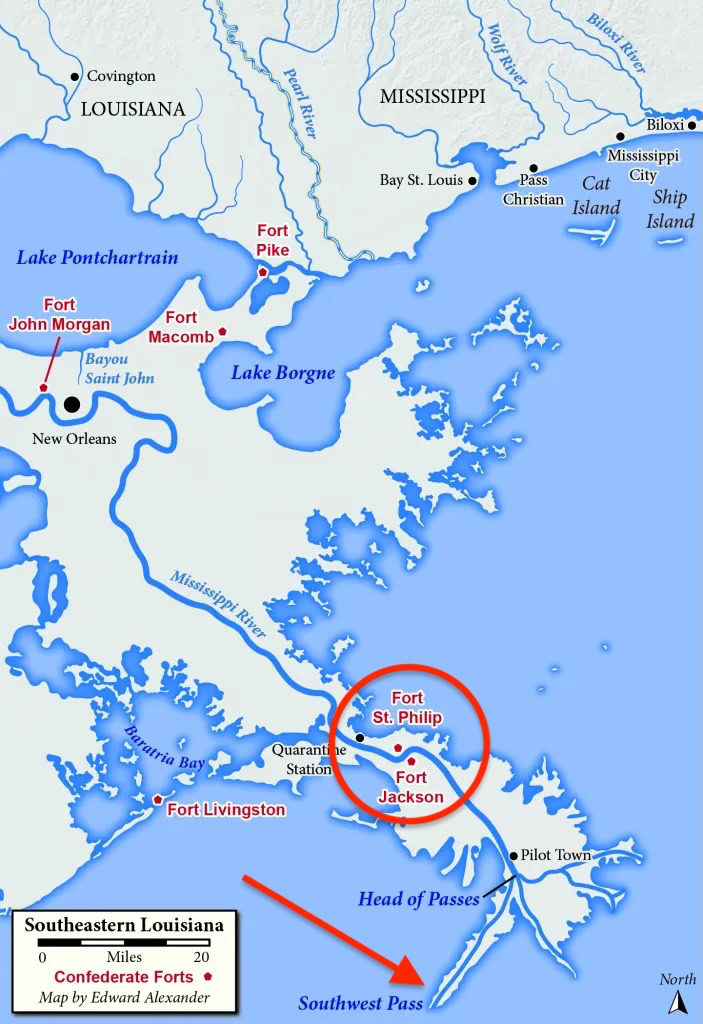
One issue that dominated the debate was the two powerful forts south of New Orleans, Forts Jackson and St. Philip. The Union Navy would have to get by these two to get to New Orleans. Commander Porter urged that a mortar flotilla should accompany the naval vessels and destroy the forts before the naval vessels attempt to pass.
The operation was approved after considerable political haggling. It has a few pieces of General Scott's earlier Anaconda Plan in it.
The Navy planned to enter the river using the Southwest Passage, the main shipping channel in the Delta area. That was approved.
Another major issue was crossing the "bar" at the mouth of the river. The "bar" is a sizable deposit of sediment usually at the middle of a channel in a river delta, which, depending on tides and a host of other scientific events, could impede the passage of ships, especially the larger warships. Commander Porter had experienced these sandbars when blockading the mouth of the Mississippi River. He considered them a significant obstacle, but one with which they could contend.
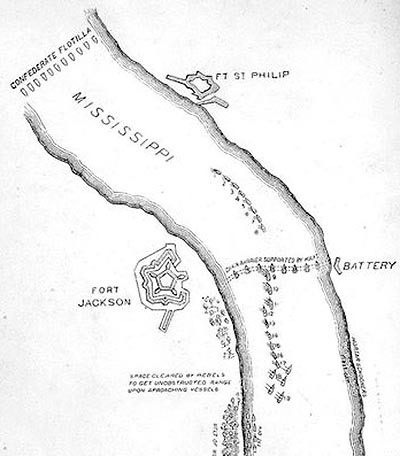
Forts Jackson and St. Philip were close to each other. The Confederacy installed an iron chain barrier across the river between Ft Jackson and a small battery on the opposite side, supported by a raft of enormous logs and eleven hulks.
Furthermore, a Confederate flotilla of 13 gunboats, including the ironclad CSN Louisiana, would await the arrival of the Union Navy should it be able to run the gauntlet and get through.
The trick for the Union Navy fleet was to get over the bar, wait for the accompanying mortar boats to destroy the forts, then make its way past the two forts, the barriers, and deal with some 16 Confederate naval ships waiting. Then and only then would the fleet press on to New Orleans and capture it.
On February 3, 1862, Captain David Farragut, USN, was named in secret orders to command the operation. He was also named as commander of the Western Gulf Blockading Squadron. Farragut's flagship was the USS Hartford screw sloop-of-war.
His orders were as follows:
“When you are completely ready, you will collect such vessels as can be spared from the blockade, and proceed up the Mississippi River and reduce the defenses which guard the approaches to New Orleans, when you will appear off that city and take possession of it under the guns of your squadron.”
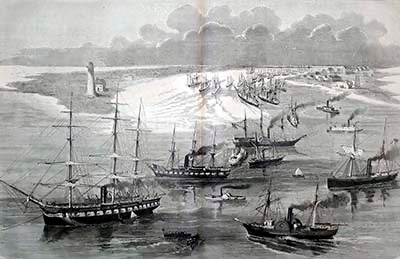
Farragut’s flagship departed Hampton Roads, Virginia, on February 3, 1862, and made its way to Ship Island on February 20. His fleet consisted of 17 ships, which arrived one by one.
The Confederacy’s leaders in Richmond felt it was more likely that New Orleans would be attacked from the north, coming downstream the Mississippi. As a result, the city itself was lightly defended.
Farragut’s fleet was ready by April 7, 1862, to head up into the Mississippi to New Orleans. Together, Farragut's ships had more than 100 heavy guns and a complement of 700 men.
The fleet assembled at Southwest Pass, the principal entry point to the river. It took two weeks to get all the ships over the bar, especially the heavier ones such as the USS Pensacola. Several had to be towed across. Cmdr. Porter's mortar gunboats also had problems. All five entrances were heavily blocked by silt.
Belatedly, the Confederates noted the Union fleet trying to cross the bars and sent down a few ships. The Union ships fired some rounds, and the Confederates left. Farragut's fleet entered the Mississippi River generally unopposed. Once they became aware of Farragut’s approach, the Confederates positioned 16 gunboats outside New Orleans.
Farragut's job was to get by the barricade, pass by the forts, take on the awaiting defenders, and capture New Orleans. Porter's job was to destroy the forts and any other shore-based threats to enable Farragut's warships to pass them.
Studying the attack on New Orleans is a fascinating way to spend your time. It was not an easy operation, but easier than one might expect.
Farragut’s fleet passed by the forts by April 24, 1862, and was closing on New Orleans. As an interesting aside, Porter's mortar boats were not able to destroy the forts. Farragut grew impatient and, in the dead of the night, ran his fleet by the forts and upriver anyway.
Major General Mansfield Lovell, CSA, saw that Farragut's fleet had passed the forts, recognized his force could not defend the city, so he withdrew it to the north. The press condemned him, but General Robert E. Lee said he did the right thing.
Farragut's fleet arrived in New Orleans on April 25, 1862. The mayor felt it was General Lovell's duty to decide whether to surrender, while Lovell said his forces had left, and therefore it was the mayor's decision. General Butler's Union ground forces had not yet arrived, so the mayor was confronted with the prospect of Farragut's fleet bombarding and destroying the city.
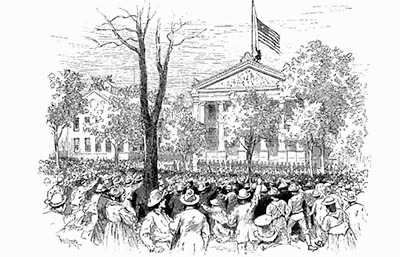
After some bickering ashore between Union naval officers and the mayor of New Orleans, a force of 250 Marines hoisted the American flag over the customs house and city hall.
For the record, the US Navy’s West Gulf Blockading Squadron captured New Orleans on April 29, 1862.
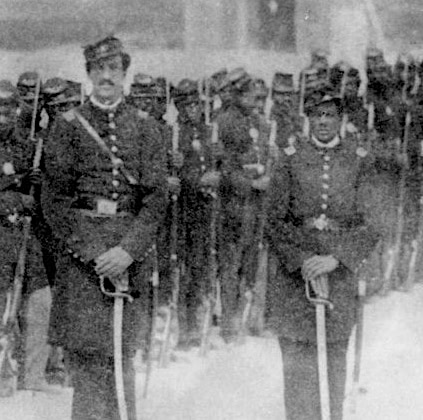
Louisiana Governor Moore felt he did not have enough ground forces to defend New Orleans, so he formed the 1st Louisiana Native Guard, CSA on May 21, 1861, long before Farragut’s assault. However, the Louisiana State Legislature had passed a law that required militia members to be white. The net result was that on February 16, 1862, the 1st Louisiana Native Guard, CSA, had disbanded.
Disbanded, perhaps, but the governor continued using the Native Guard until Farragut’s fleet arrived in New Orleans in April 1862. The Native Guard was sent to the French Quarter at the eleventh hour to help defend it. But New Orleans fell.
Let’s turn to General Butler’s ground forces and their arrival in New Orleans.
I mentioned Ship Island earlier, pointing to its superb location outside the mouth of the Mississippi River, perfect to function as a depot and staging base. The Union captured the island in September 1861. General Butler, USA, brought ground forces from Massachusetts and occupied Ship Island, Mississippi, on March 20, 1862.
Butler was the commander of the Department of the Gulf of the US Army, which had been formed on February 23, 1862. This department was responsible for all the coast of the Gulf of Mexico west of Pensacola harbor, and as many of the Gulf States as may be occupied by its forces.
Butler activated his command at Ship Island. Some 15,000 Union troops had landed there by May 1, 1862. This ground force helped capture and hold New Orleans, even though Farragut had already taken it.
Butler was disliked by almost everyone who knew him. He plundered Southern households and labeled women who showed contempt for Union soldiers as prostitutes. Confederate President Jefferson Davis labeled Butler an outlaw.
Military and civilian planners on both side wrestled with what to do with the slaves during the war.
Butler was an educated lawyer. He developed a policy that said slaves who ran away into Union lines were “contraband of war.” The Fugitive Slave Act of 1850 stipulated that escaped slaves, upon capture, were to be returned to their masters. However, Butler reasoned that since the rebel forces would use these fugitives to wage war against the US, he intended to confiscate them as property and contraband of war. In short, he would not follow the Fugitive Slave Act.
On this matter of slaves as “contraband,” the US Army (and the United States Congress) determined that the US would not return escaped slaves who went to Union lines. Instead, it classified them as contraband. The Army used many as laborers to support Union efforts and soon began to pay them wages. So the Fugitive Slave Act of 1850 was effectively dead.
Click to zoom graphic-photo