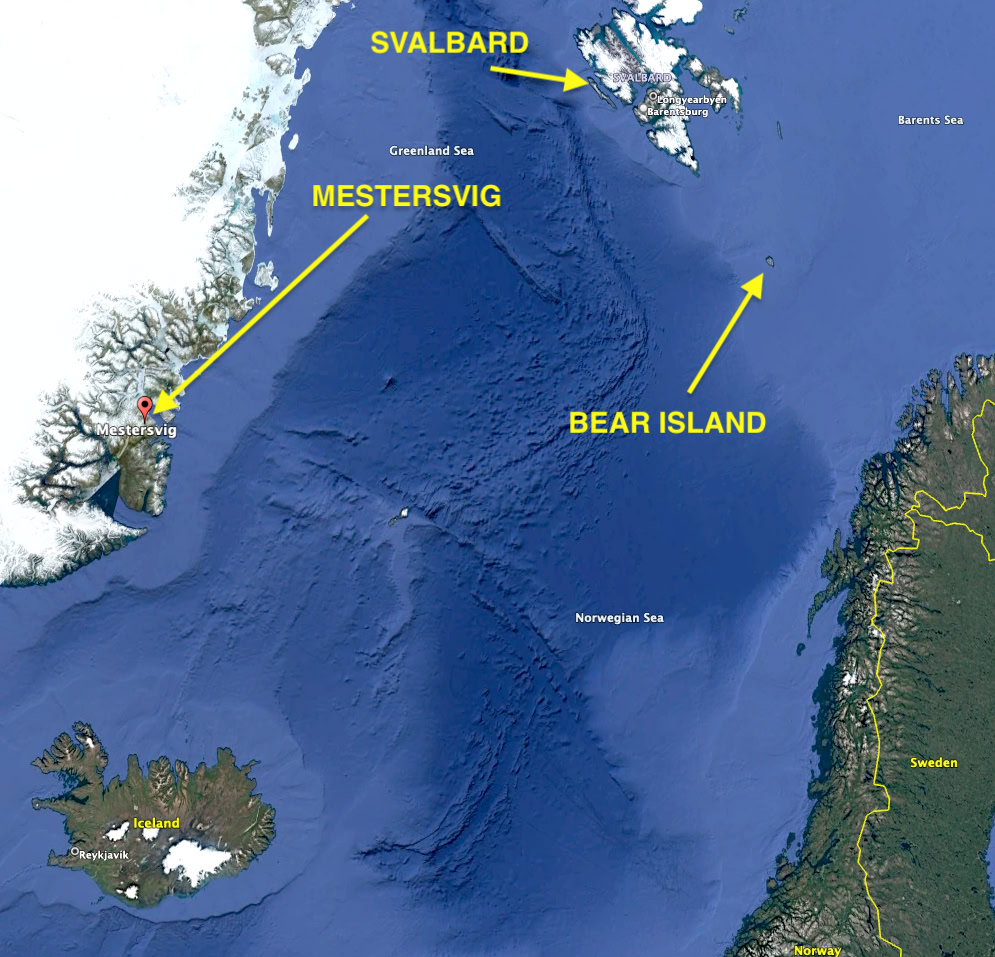
The Svalbard-Bear Island Gap
Greenland aside, Svalbard is a “Wild Card”
Introduction
There was a time when the Arctic was seen as an “international zone of peace.” No more. It is increasingly viewed as a region of great power rivalry.
Most are aware that President Trump wanted to take control of Greenland. He has not been subtle or even diplomatic. His rhetoric implies a yearning for full control over the defense of North America. His remarks about annexing Canada are driven by much the same impulse.
President Trump’s idea of buying Greenland is not new.
During or shortly after WWII, the JCS recommended that the US purchase Greenland from Denmark. The Secretary of State, James Byrnes, discussed the proposal with Danish Foreign Minister Gustav Rasmussen in December 1946, and Rasmussen responded that he would give the idea “careful study.”
In January 1955, the Joint Chiefs of Staff (JCS) recommended to the Secretary of Defense (SecDef) that the US acquire title to Greenland. The State Department disagreed, and the suggestion was filed in the “too hard to handle” box during the Eisenhower Administration.
Legitimate American national security needs lie beneath President Trump’s rhetoric. Underlying those needs are important organizational demands and technological developments that the president did not address in his discussion of Greenland.
Denmark and the US are negotiating over the US establishing more bases in Greenland. The scuttlebutt is that the US wants three, mainly in the south. The negotiations are being held in secret, so I do not know what the US has in mind. But I do have an idea.
The consensus is that the US is seeking air bases with runways and support infrastructure, and perhaps usable port facilities. I have heard of two possibilities and perhaps a third,
- Qaqortoq Airport serves the largest town in southern Greenland. Located in the far south, the airport could be shared with the US military, as it is in so many places abroad, as part of its “lily pad” strategy. However, Qaqortoq’s port has minimal facilities and can handle only small patrol boats. Narsarsuaq, 10 miles to the north, was used by the US during WWII and known as “Bluie West-One” (BW-1). It could serve as a heliport for ice-observation flights, or the US might prefer it to Qaqortoq. It once hosted a 1,000-bed hospital.
- Kangerlussuaq, known as Sondrestrom during WWII, is a good candidate, though it is above the Arctic Circle. It has a road to a port for support and was used by various USAF commands into the 1980s. It is on the west coast, across the Davis Strait and the Canada-US Northwest Passage.
- Ilulissat, by Greenland standards, is a large town. It is on the west coast, has an airport about two miles northeast of the town, has a port, and is on the Davis Strait. It was not used by the US during or after WWII.
I have pondered why the US might want such bases. They could serve as aircraft staging bases to deter Russian bombers and monitor the sea lines of communication (SLOC). The US Navy (USN) wants to deploy its ships, including aircraft carriers, into the Arctic, so a port and suitable runway over there could be useful.
The US already operates the Pittufik Space Force Base far to the north. Its Upgraded Early Warning Radars (UEWRs) can detect Intercontinental Ballistic Missile (ICBM) launches and prompt missile interceptors elsewhere to destroy the ICBMs. It has a runway and support facilities and has hosted US fighter deployments during exercises. Pittufik can also detect aircraft, but not at low altitudes.
General Gregory Guillot, USAF, the US commander of Northern Command (NORTHCOM), has advocated an increased military presence in Greenland to provide decision-makers with more options for a strategy to deter and deny Russian and Chinese approaches to North America.
Nevada Joan Lee of the European Council on Foreign Relations has raised an interesting notion, suggesting that Norway’s Svalbard Archipelago might well emerge as a “wild card” in the effort to deny and deter aggression from the Barents Sea through the Norwegian Sea and into the North Atlantic Ocean.
Lee presents two scenarios the US could pursue to gain greater influence, if not control, over this archipelago. Her work aligns with a statement made by Elizabeth Buchanan, a “Canadian-borne Australian” geopolitical research professional,
“Competitors are jostling for Arctic domination.”
NOTE BENE: The governments of Denmark, Greenland, and the US signed an agreement on September 22, 2026 that the US can establish military bases at Narsarsuaq in southern Greenland and Mestersvig in eastern Greenland. Narsarsuaq is 10 miles north of Qaqortoq Airport mentioned earlier.
“Arctic domination?”
Russia
The Arctic is a relatively new frontier. In my view, Russia has an advantage because it has opened the Northern Sea Route (NSR), the shortest maritime route between Europe and the Pacific. The NSR extends about 3,000 miles along the breadth of Russia’s northern coast.
The Russians have worked hard and invested boatloads of money to bring the NSR to market. China, France, and Japan have invested as well. Russia and its energy companies are developing major natural gas fields in the region.
The Northern Sea Route (NSR) has driven Russia’s Arctic Policy 2035.
The Center for Global Europe has said,
“The stage is set for geopolitical challenges to emerge in the high north (because of the) new abundance ofoil, gas, and rare earth metals and critical raw materials.”
Russia’s plan is to use Arctic-qualified ships to pick up these energy products and deliver them to ports in Asia and Europe via the NSR. China is using the NSR to send oil and gas tankers to fill up and transit to global markets. China also sends its container ships carrying its products to European and American markets.
The NSR includes several seaports on the NSR including Sabetta, Dickson, Dudinka, Khatanga, Tiksi, Pevek, and Cape Dezhnev.
Russia covets the NSR and aims to tightly control maritime traffic along it. There is no Freedom of Navigation Operation (FONOP) along the NSR.
Rosatom, Russia’s state-owned national nuclear corporation, is the sole operator of the NSR infrastructure. It is a powerful state company, well-managed and disposed to serve as a geopolitical tool.
Through its subsidiary, Atomflot/Rosatomflot, it operates the world’s only nuclear-powered icebreakers, which keep the NSR open and increase its traffic throughput.
The Russian Nagurskoye air base guards the entrance to the Barents Sea. It has received significant investment and is said to be operational year-round and capable of handling any aircraft. It hosts the Bastion missile defense system, which can engage surface ships, including carrier battle groups, using its P-800 Oniks supersonic anti-ship missile.
The Russian Northern Fleet is headquartered in Severomorsk on the Kola Peninsula, with naval bases throughout the peninsula. It is subordinate to the Russian Navy, not to the five military districts. This fleet is a critical strategic asset for Russia. A wide array of Russian naval ships is based here, with the most lethal being Strategic Ballistic Missile Submarines (SSBNs). These multirole submarines frequently sail into the Atlantic.
Russia most certainly intends to establish hegemony over its Arctic holdings and to have its Navy patrol the North Atlantic at will.
Russia reorganized its military districts to better prepare for the Arctic and for NATO on European soil. This move followed Sweden and Finland's NATO membership. Russia now shares an 830-mile border with a NATO member, Finland. This development prompted Russia to rethink its defense strategy.
Russia eliminated the Western Military District (WMD). It covered much of western Russia facing NATO. The leadership felt it was too large and unwieldy.
The Russians eliminated the WMD and assigned its responsibilities to two military districts, the Moscow and the Leningrad Military Districts, and took a curious action regarding the Northern Fleet,
- Leningrad Military District (LMD): Headquartered in St. Petersburg on the Baltic Sea in northwestern Russia, the LMD’s Area of Responsibility (AOR) includes the border regions of Finland, Norway, and Sweden. The Northern Fleet’s air and ground resources were assigned to the LMD.
- Moscow Military District (MMD): Headquartered in Moscow, its AOR includes central and western Russia, as well as border areas with Ukraine, Belarus, and Poland.
- The Russian Northern Fleet, headquartered on the Kola Peninsula, became independent of any military district. Its land and air resources were assigned to the LMD, but its surface and subsurface forces remained under the command of the Northern Fleet and were subordinate to the commander of the Russian Navy.
All military responsibility for Russia's Arctic territories was consolidated under the LMD to secure all Russian interests and project power in the region.
President Putin noted in April 2026, according to Pravda, that Russia was “strengthening the Arctic logistics framework, including sea and river ports, railways and highways, and airports.” He commented, “Geopolitical competition and the struggle for positions around the Arctic zone itself are intensifying.”

Table of Contents
Arctic Domination?
Russia
China
US Defense Policy
NATO organizational reshuffle
Sea Lines of Communication: High North
Greenland-Iceland-United Kingdom Gap
Svalbard and the Bear Island Gap
A note on the Gray Zones