Kamikaze attacks USS Comfort hospital ship
“Kamaretta red, smoke boat make smoke"
Meet the USS Comfort AH-6
The US Medical Research Centre has published a detailed historical summary of US hospital ships. I commend this to you.
Before we get going, I’ll note that the USS Comfort (AH-6), which is the subject of this report, is one of three.
The USHS Comfort hospital ship (AH-3) was used in WWI. It was converted from a passenger ship. After several modifications, she reemerged as the US Army Hospital Ship (USAHS) Shamrock and served in the invasions of North Africa, Sicily, and Italy. After the war, she was scrapped.
There is also a USNS Comfort (T-AH-20) that was commissioned in 1986, long after WWII. She was converted from an oil tanker into a hospital ship. She is owned by the US Navy and crewed by civilians from the Military Sealift Command. When the Comfort is deployed, a team of uniformed naval hospital staff and naval support personnel is embarked.
Our focus is WWII in the Pacific and the second USS Comfort (AH-6).
The harsh reality was that in 1942, American-built military hospital ships didn’t exist. You’ve read about a few troopships with medical capabilities. The Army and Navy had to build everything from scratch, including hospital ships. That’s the US for you — always asleep at the switch, always playing catch-up.
The hospital ships ordered by the Army became available at the end of 1943. While the Army controlled these ships, the Navy was responsible for building, commanding, and operating them. The medical staff aboard was Army. By the end of WWII, the Army had 24 hospital ships. The Navy also had some where the medical staff was Navy.
The Consolidated Steel Corp. in Wilmington, CA, launched the USS Comfort with hull number 1021 on March 18, 1943. The Wilmington shipyard was an emergency facility built in 1941. The ship was known as a C1-B Cargo Ship. When a ship is launched, it means it is transferred to the water.
First Lieutenant Eunice Hatchitt, US Army Medical Corps, a nurse, sponsored the launch of Comfort. Lt. Hatchitt had served in the battlefield hospital in the Philippines on Bataan. She and 21 other nurses were moved to Corregidor and narrowly escaped at the last minute aboard a Navy PBY Catalina amphibious aircraft. The rest were imprisoned.
Sponsoring a ship’s launch is always left to a woman. She breaks a bottle of champagne against the ship’s bow to bestow good luck and formally name the ship.
The Comfort was designed for economical, long-distance cargo transport. She had limited speed, with a maximum of 14 knots, but her range was 13,000 miles.
All hands knew that this Army “cargo ship” would be a hospital ship. She was transferred to the Navy on the day she was launched.
After she was launched, Bethlehem Steel Co. in San Pedro, CA, converted her into a hospital ship. She was one of three Comfort-class hospital ships, the other two being USS Hope (AH-7) and USS Mercy (AH-8). All three served in the Pacific.
The USS Comfort was commissioned on May 5, 1944. Commissioning a ship means she was officially placed into active service
The Army’s goal was to evacuate the wounded and transport them to a hospital away from the battle. In that sense, the Army viewed the hospital ship as a transport vessel, an evacuation platform that would move casualties from the front lines to hospitals in the rear.
In contrast, the Navy built hospital ships crewed by Navy personnel that served as fully equipped hospitals. They received casualties, cared for them, and provided logistical support to front-line medical teams. The USS Relief is such a ship, far more elaborate than the Comfort-class ships. More on the Relief later, as she was with the Comfort offshore Okinawa.
The Comfort (AH-6) had three fully equipped surgical operating rooms, recovery wards, and several clinics.
All US hospital ships were painted white, with large red crosses on both sides and three sides of the smokestack. A prominent five-foot green band ran along the hull above the waterline, all meant to identify it as an unarmed, non-combatant hospital ship.
The Army Table of Organization and Equipment, the TO&E for hospital ships, was developed in 1942, before the Army even had a hospital ship. It called for 12 Medical Corps officers, a warrant officer, 35 nurses, and 99 enlisted men.
The Army estimated that such a medical team could care for 500 patients. The ship carried about 200 Navy crew members and Army medical personnel. I do not know the exact composition of the medical crew on the Comfort, though the Army crew of the Comfort was designated as the 205th Medical Hospital Ship Complement.
The Army medical teams on board worked to get their patients to the hospital, whether performing surgery, treating diseases like malaria, cholera, dengue fever, and dysentery, or stabilizing injuries. Flash burns, extensive chest wounds, mutilated limbs, and massive hemorrhages were often seen as a result of bomb blasts and mortar fire.
Comfort set sail from San Pedro in June 1944, heading to Brisbane, Australia, then proceeded to Hollandia, New Guinea, where a major Army hospital center was established to treat casualties from the battles in the Philippines. She filled up twice with patients and transported them to San Pedro in November and December 1944.
She returned to the Philippines in February 1945, took on more wounded, and then transported them to Hollandia. Comfort went back to the Philippines in March to pick up more troops, then headed to Okinawa, where the invasion had just begun on April 1, 1945, named “Operation Iceberg.”
The Comfort and USS Relief (AH-1) arrived on April 2. The USS Hope (AH-7) arrived in Okinawa on April 9, and the USS Mercy (AH-6) arrived in mid-April. They both sailed back and forth to deliver patients to Saipan.
General Douglas MacArthur, USA, was in command, supported by Admiral Chester Nimitz, USN. Forces from the UK, Australia, New Zealand, and Canada took part.
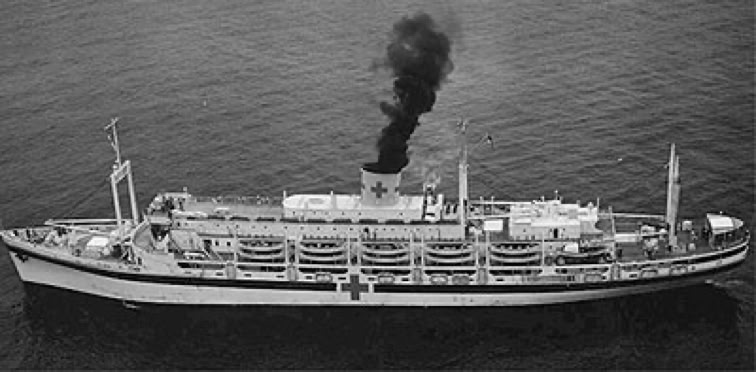
Click to zoom graphic-photo
Click to zoom graphic-photo


Ed Marek, editor

Marek Enterprise
224 N Barstow St Suite 426
Eau Claire, WI 54703
© Copyright 2025
